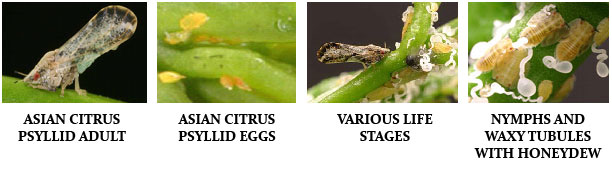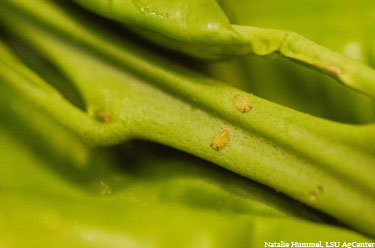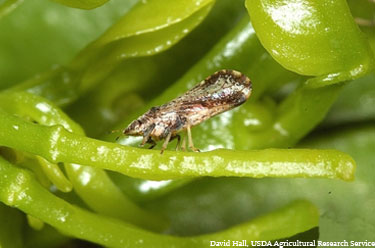
Asian Citrus Psyllid (ACP) is an insect pest capable of spreading
Huanglongbing (HLB), a devastating bacterial disease of citrus trees. HLB is transmitted to healthy trees by the psyllid after it feeds on infected plant tissue. ACP feeds mainly on
Citrus spp., as well as at least two species of Murraya and several other plant species.
ACP has been detected in Alabama, Hawaii, Mississippi and Texas. Both ACP and the disease have been found in Florida, Georgia, Louisiana and South Carolina. Both ACP and HLB have been detected in Mexico as well. HLB infected psyllids have caused devastation to citrus in Asia, India, parts of the Middle East and South and Central America. ACP can be spread by movement of incoming nursery stock, citrus fruit with leaves, stems, contaminated conveyances, etc. ACP early detection is key in preventing the spread of this insect pest and the potential spread of HLB.
ACP has not been detected in Kern County but has been found in southern California counties.
HLB has not been found in California.
The California Department of Food and Agriculture (CDFA) and County Agricultural Commissioners are placing ACP traps in buffer zones within three miles of commercial citrus orchards at a rate of 15 traps per square mile in citrus producing counties.
On Monday, March 8, 2010 Kern County Department of Agriculture staff members began placing yellow panel sticky traps within the three mile buffer zone around commercial citrus orchards in the southern part of the county. A total of 6,765 traps will be set in Kern County. Every trap will be located using GPS technology. This will allow for mapping ACP presence/spread and also for recording areas surveyed with no ACP found. The traps will be checked monthly and will be maintained through September 2010.